

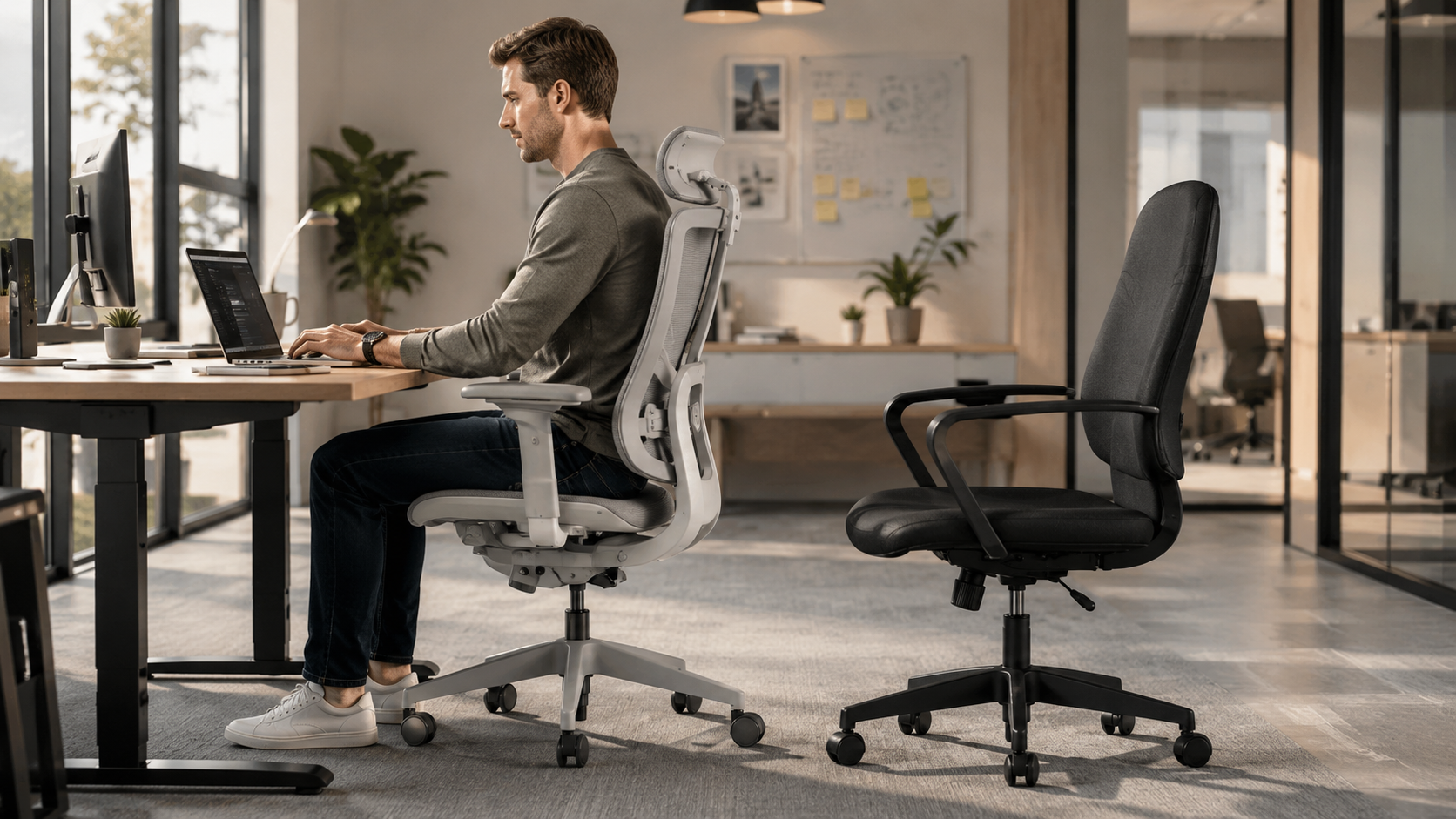
When shopping for a new chair, you may see two common terms everywhere: office chair and ergonomic chair. At first, they may seem similar. Both are designed for desk use, both usually have wheels, and both can be used for work, study, or home office setups.
But they are not always the same. A regular office chair is mainly designed to provide a place to sit. An ergonomic chair is designed to support the body more effectively during long periods of sitting. The difference becomes especially important if you spend several hours a day at your desk.
In this guide, we’ll explain the key differences between an ergonomic chair and a regular office chair, what features matter most, and how to decide which one is right for your workspace.
What Is a Regular Office Chair?
A regular office chair is a general-purpose chair designed for desk work. It may include basic features such as seat height adjustment, a swivel base, wheels, and a simple backrest. For short periods of sitting, a basic office chair may be enough.
However, many regular office chairs have limited adjustability. The backrest may not properly support the lower back, the armrests may be fixed, and the seat depth may not match different body types. Over time, these limitations can affect comfort, especially during long workdays.
A standard office chair is often built around convenience and affordability. An ergonomic chair is built around body support, adjustability, and long-term sitting comfort.
What Is an Ergonomic Chair?
An ergonomic chair is designed to better support the human body while sitting. Instead of forcing your body into one fixed position, an ergonomic office chair usually provides adjustable features that help the chair fit your body, desk height, and sitting habits.
A good ergonomic chair may include lumbar support, adjustable seat height, adjustable seat depth, adjustable armrests, a reclining backrest, breathable mesh, a headrest, and sometimes a footrest. These features work together to help improve sitting comfort and support better posture throughout the day.
The main purpose of an ergonomic chair is not simply to feel soft. It is to provide stable, flexible, and targeted support for long hours of work, study, or computer use.
Ergonomic Chair vs Office Chair: Main Differences
The biggest difference between an ergonomic chair and a regular office chair is adjustability. A regular office chair may provide basic sitting support, but an ergonomic chair is designed to adapt to different users and different sitting positions.
Here are the key areas where they differ.
1. Lower Back Support
Many regular office chairs have a simple backrest with limited lower back support. This may feel acceptable at first, but after several hours, your lower back may start to feel unsupported.
An ergonomic chair usually provides dedicated lumbar support. Lumbar support helps follow the natural curve of the lower spine and may help reduce pressure around the lower back during long sitting sessions.
Some ergonomic chairs go further with dynamic lumbar support. This type of support can respond to posture changes, making it useful for people who move between upright sitting, leaning back, and relaxed positions throughout the day.
2. Adjustability
A regular office chair may only allow you to adjust the seat height. Some may also include a basic tilt function. However, this may not be enough for people with different body types, desk heights, or sitting habits.
An ergonomic chair typically offers more adjustment options. These may include seat height, seat depth, armrest position, backrest recline, headrest height, lumbar support, and tilt tension.
More adjustability means the chair can better fit your body instead of requiring your body to adapt to the chair.
3. Seat Comfort and Seat Depth
Seat design plays a major role in long-term comfort. A regular office chair may have a fixed seat size that works for some users but not for others.
If the seat is too deep, it can press against the back of your knees. If it is too shallow, your thighs may not get enough support. This is why adjustable seat depth is an important ergonomic feature.
An ergonomic chair with adjustable seat depth can better match different leg lengths, helping users sit with more balanced support.
4. Armrest Support
Fixed armrests can be a problem if they do not match your desk height or natural arm position. Armrests that are too high can raise your shoulders. Armrests that are too low may fail to support your arms properly.
Ergonomic chairs often include adjustable armrests that can move up, down, forward, backward, or sideways depending on the design. This helps support your arms while typing, reading, working, or gaming.
Good armrest positioning can also help reduce unnecessary tension around the shoulders and upper body.
5. Recline and Movement
A regular office chair may have a basic tilt mechanism, but it may not offer controlled support when leaning back. Some chairs feel stiff, while others feel unstable.
An ergonomic chair is usually designed to support movement. A reclining backrest allows you to change posture during the day, which can make long sitting sessions feel more comfortable.
A good recline should feel stable and supportive, giving you the option to sit upright when focused and lean back when taking a break.
6. Materials and Breathability
Many standard office chairs use padded cushions, synthetic leather, or basic fabric. These materials may feel comfortable at first, but they can trap heat during long sitting sessions.
Many ergonomic chairs use breathable mesh to improve airflow. Mesh can help reduce heat buildup, especially in home offices, warm rooms, or long work sessions.
This does not mean mesh is always better for everyone, but it is often a strong choice for users who want cooler, more breathable comfort.
7. Long-Term Sitting Performance
A regular office chair may work well for short tasks, occasional desk use, or temporary setups. But if you sit for many hours every day, small comfort problems can become more noticeable.
Ergonomic chairs are usually better suited for long-term use because they provide more support, more adjustment, and more flexibility.
If your chair is part of your daily work environment, choosing the right one can make a meaningful difference in your comfort and productivity.
Quick Comparison: Ergonomic Chair vs Office Chair
| Feature | Regular Office Chair | Ergonomic Chair |
|---|---|---|
| Primary Purpose | Basic desk seating | Body support and long-term comfort |
| Lower Back Support | Often limited or fixed | Usually includes dedicated lumbar support |
| Adjustability | Basic height adjustment | Multiple adjustable features |
| Seat Depth | Usually fixed | May be adjustable for better leg support |
| Armrests | Often fixed | Often adjustable |
| Recline | Basic or limited | More controlled and supportive |
| Best For | Short-term or occasional use | Daily work, study, gaming, and long sitting hours |
Is an Ergonomic Chair Always Better?
Not always. The better choice depends on how often you sit, how long you sit, and what kind of support you need.
If you only sit at a desk for short periods, a basic office chair may be enough. For example, if you use your desk for quick tasks, occasional reading, or short computer sessions, you may not need a highly adjustable ergonomic chair.
However, if you work from home, sit for several hours a day, or often feel discomfort from your current chair, an ergonomic chair is usually a better long-term choice.
Who Should Choose an Ergonomic Chair?
An ergonomic chair is worth considering if your chair is part of your daily routine. This includes office workers, remote workers, students, gamers, designers, programmers, writers, and anyone who spends long hours at a desk.
You may benefit from an ergonomic chair if:
- You sit at your desk for four or more hours per day.
- Your current chair feels uncomfortable after long use.
- You need better lower back support.
- You often adjust your posture to find comfort.
- You want one chair for work, study, and relaxation.
- You need a chair that can adapt to your body and workspace.
Who Can Use a Regular Office Chair?
A regular office chair may still be suitable for short-term or light use. If you do not spend much time at a desk, or if you need a simple chair for occasional tasks, a basic office chair can still be practical.
It may also be a budget-friendly option for temporary setups, guest rooms, or spaces where the chair is not used daily.
The key question is not whether a regular office chair is bad. The question is whether it gives your body enough support for how you actually use it.
How to Decide Which Chair Is Right for You
Before choosing between an ergonomic chair and a regular office chair, think about your daily sitting habits.
Ask yourself these questions:
- How many hours do I sit each day?
- Do I often feel discomfort in my lower back, neck, shoulders, or hips?
- Do I need adjustable armrests, lumbar support, or recline?
- Do I work from home or use my desk every day?
- Do I prefer breathable mesh or padded cushioning?
- Will more than one person use the chair?
If you sit for long hours and want better support, an ergonomic chair is likely the stronger choice. If you only need a chair for occasional use, a standard office chair may be enough.
What Features Matter Most in an Ergonomic Office Chair?
If you decide to choose an ergonomic chair, focus on features that directly affect comfort and support. The most important features usually include lumbar support, adjustable seat height, adjustable seat depth, flexible armrests, recline, breathable material, and a stable base.
These features help the chair support different body types and different sitting positions. They also make the chair more suitable for long daily use.
For example, adjustable seat depth helps improve leg support. Dynamic lumbar support helps support the lower back as your posture changes. Breathable mesh helps keep the sitting experience cooler. A reclining backrest gives you more flexibility between focused work and relaxed breaks.
Final Thoughts
The difference between an ergonomic chair and a regular office chair comes down to support, adjustability, and long-term comfort. A regular office chair may be enough for short periods of sitting, but an ergonomic chair is usually better for people who spend hours working, studying, gaming, or using a computer every day.
If your chair is part of your daily routine, it should do more than simply give you a place to sit. It should support your posture, adapt to your body, and help make long hours at your desk feel more comfortable.
If you are looking for an ergonomic mesh office chair with dynamic lumbar support, adjustable seat depth, flexible armrests, a reclining backrest, and an extensible footrest, OTO Zenpex is designed for long workdays, focused sessions, and more comfortable everyday sitting.

FAQ
What is the main difference between an ergonomic chair and an office chair?
A regular office chair is designed for basic desk seating, while an ergonomic chair is designed to provide better body support, adjustability, and comfort during long sitting hours.
Is an ergonomic chair worth it for working from home?
Yes, an ergonomic chair can be worth it if you work from home for several hours a day. It can help improve sitting comfort and provide better support than a basic chair.
Can a regular office chair be ergonomic?
Some office chairs include ergonomic features, but not all office chairs are truly ergonomic. Look for lumbar support, adjustable seat depth, adjustable armrests, and a supportive recline.
Are ergonomic chairs only for office workers?
No. Ergonomic chairs can also be useful for students, gamers, remote workers, designers, programmers, and anyone who sits at a desk for long periods.
What should I look for when buying an ergonomic office chair?
Look for adjustable lumbar support, seat height, seat depth, armrests, recline, breathable materials, and a stable base. These features help the chair better fit your body and workspace.
What Is an Ergonomic Chair and Do You Really Need One?
How to Choose the Best Ergonomic Chair for Your Home Office?